BLOGS

C-Probe Systems Win at the British Construction Industry Awards!

C-Probe are delighted to announce that we have won the ‘Environment and Sustainability Initiative of The Year’ at the 2023 British Construction Industry Awards (BCIA). BCIA, which is jointly organised by New Civil Engineer and the Institution of Civil Engineers, crowned the winners of a variety of categories focused on sustainability and innovation on 11th October at the Grosvenor House Hotel, London.

Celebrating its 36th anniversary in 2023, the BCIA brought together more than 1,000 of the UK’s leading clients, consultants and contractors for a glittering evening of celebration, recognition and networking.

The Environment and Sustainability Initiative of The Year’ category recognises a specific project-based initiative that involves a low carbon solution, specifically boosting the whole life performance and improving environmental sustainability. We created a submission named ‘Whole Life Preservation of Embodied Carbon and Structural Resilience’ focusing on our restoration work completed on the Omni Centre Car Park in Edinburgh. After face-to-face review by a panel of expert judges, C-Probe won!

Figure 1 – Chases filled in at the Omni Centre Car Park

We designed, manufactured and supplied the low carbon materials and management systems which would provide long-term control over the corrosion issue that was affecting the safety and functionality of the busy 4-level car park. Impressed Current Cathodic Protection (ICCP) was adopted as a protection method where existing high corrosion risk was most prevalent along with high chloride concentrations within the concrete cover. This strategy was adopted to ramps and decks on certain levels of the structure, and concrete repairs were protected with galvanic anodes (GCP) with the remaining deck areas receiving surface-applied corrosion inhibitor.

+chase® was adopted as the anode material for this project – this is manufactured from novel binders of repurposed industrial wastes in the form of alkali-activated cementitious materials (AACM geopolymer) with a carbon emission (CO2e) some 90% less than Portland CEM1, and 50-67% less than other CEM categories. They are also empathic in use with the parent concrete as the geopolymer materials bond as a mortar within chases to the parent concrete with hardening characteristics in compressive and flexural strengths similar to the existing structure.

Collaborating with Makers Construction Ltd, the chosen contractor, and the overseeing engineer, Waterman Structures, installation was successfully carried out helping to preserve over 8 million kg of embodied carbon for over 25 years with targeted and minimal repair, adding a mere 90,000 additional kg of carbon. The corrosion management strategy also included online control and performance assessment of the installed system tracking service life with data to prove its resilience into the future. The use of such remote contact minimises the need for travel to site contributing to the low carbon sustainability approach to the project.

The judges commented on our submission and presentation:

The cost of corrosion in buildings and infrastructure has been estimated at 3.4% of GDP – so these measures, widely applied, have the potential to offer significant benefits to our economy and environment. It is maximising the use of the embodied carbon in existing structures in an exemplary way.”

This initiative goes to the heart of sustainability in that the technology being deployed is extending the life of existing structures by considerable margins by addressing the problem of corrosion of steel reinforcement, allowing them to be reused or repurposed, rather than be demolished and replaced in line with PAS 2080 principles. It is being delivered by an amazing SME…”

Omni Car Park continues to be protected to do this day. Our methods of sustainable resilience use low carbon materials, such as +chase®, integrated within a long-term strategy which preserves the structure’s embodied carbon for generations, whilst harnessing structural data to continuously assess performance for transparency and accountability around corrosion rate.

Figure 2 and 3 – During and completed works at the car park

Belinda Smart, deputy editor of New Civil Engineer, commented:

“The standard across all award categories was particularly impressive this year. The BCIA programme not only celebrates excellence in the construction industry but enables industry peers and colleagues to share knowledge and innovation and to inspire each other. With climate change and rising costs continuing to present sectoral and societal challenges, this year’s winners demonstrate industry’s willingness and ability to rise to those challenges, with solutions that benefit the wider community.”

The full list of winners can be found at: https://bcia.newcivilengineer.com/

If you’re interested to learn more about C-Probe’s low carbon corrosion management products and services, please visit www.c-probe.com, or email cwalker@c-probe.com

C-Probe’s Highlights from the Offsite Show 2023

C-Probe Systems recently exhibited at the Offsite Show 2023 based at the London ExCeL and were gold sponsors of the Buildoffsite Innovation Hub. The exhibition created an opportunity for construction professionals to share knowledge through presentations and networking around adopting innovation and modern methods of construction. Both are incredibly important as the sector transitions towards more sustainable methods and achieving important milestones like NetZero.

Day one of the exhibition focused on presentations on the Buildoffsite Theatre, with Graeme Jones, MD of C-Probe Systems, delivering two across the day. The first, Can offsite make a concrete change with low carbon precast?, was a panel style discussion with industry experts from the likes of C-Probe, Amcrete, Mott Macdonald and Laing O’Rourke. We highlighted the use of our alkali activated cementitious (AACM geopolymer) anode mortar, which is used for the preservation of existing infrastructure through corrosion control by forming a full resilience management system with embeddable probes and remote monitoring.

Graeme went onto highlight the successes learnt within the restoration sector, and how these can be applied to new construction through a modular impressed current cathodic protection (ICCP) component which is attached on the steel rebar before cement is poured. The LoCem® Modular Anode Unit (MAU) would create sustainable resilience for new infrastructure due to control of corrosion. This means prevention of structural disrepair and preservation of the embodied carbon created in the construction processes.

Graeme Jones commented during the session:

The opportunity to add a ‘kit of parts’ that manages [structural] resilience is an innovation and is not used as a norm [currently in the sector]. Everything is now in place to build a structure that doesn’t deteriorate in the long-term, and it starts with low carbon materials.

The next presentation, Corrosion and Extending Asset Lifespan, was presented later in Day 1 and at the Concrete Expo. The presentation focused on the issue of corrosion itself, the social and financial effects structural disrepair has and the technology that is available to control this. Key facts were highlighted during the presentation such as:

  • 70% of infrastructure damage is caused by corrosion (NACE Impact Report, 2016)

  • This translates to 3.4% of GDP lost each year in each country due to corrosion damage.

Using repurposed industrial wastes for replacing concrete, such as LoCem®, and for corrosion control also repurposes previous embodied carbon rather than producing new materials. Alongside this, existing structures and new structures are protected through corrosion management methods that can assure service life and preserve embodied carbon for over 100 years. The Offsite Show provided a great space for a range of professionals to get together who are eager to drive change in the construction sector. For C-Probe, we want to achieve that through a componentised kit of parts for use in new construction. The ability to provide corrosion protection from day one of a structure’s construction will prevent future disrepair with all the same sustainability and ESG benefits. We look forward to seeing further progression and updates at the new UK Construction Week in the upcoming October!

For more information, visit www.c-probe.com or contact Cassie Walker (cwalker@c-probe.com).

Using Offsite Construction to Reduce Carbon and Control Corrosion

It is evident that the construction sector has many opportunities to cut carbon emissions in order to contribute to NetZero, mainly within projects, materials and processes. Altering the way we add to or restore the built environment and building more efficiently, via offsite construction and with low carbon build materials, is key. If this is done effectively, the speed at which climate change is progressing will be cut significantly.

Offsite construction and manufacture offers many benefits to the sector through reducing costs and efficiency, compared to traditional onsite construction. Offsite construction is usually quicker in its speed to completion, which in turn reduces delays, site waste and transport requirements. Therefore, using offsite technology presents a good opportunity to reduce the industry’s carbon footprint.

The investment of new infrastructure is inevitable, despite the notion that we should preserve the structures we already have in efforts to support a circular economy.  If this is the case, corrosion protection should be considered in the earliest design stages – the NACE Impact Report (2016) found that 70% of infrastructure damage is caused by corrosion, therefore highlights what a significant, yet overlooked, problem it is in the industry.   Protecting the internal steel frame is imperative for resilience, safety and functionality of a structure, and also in terms of protecting the outside fabric as corrosion causes concrete to crack and spall.

Steel corrosion

Corrosion  causes 70% of infrastructure damage

C-Probe Systems have combined both elements of corrosion protection and offsite manufacture, through their modular ICCP moulded anode: the LoCem® Modular Anode Unit (MAU). The MAU is an impressed current cathodic protection (ICCP) component used for corrosion protection and monitoring in newly built structures. By implementing this component at the earliest construction stage, where the component is attached to the steel rebar of infrastructure before the concrete is poured, it would be saving tonnes of embodied carbon through the prevention of future disrepair arising from corrosion, thereby creating more resilient, sustainable infrastructure.

LoCem MAU

The LoCem® MAU

As its name suggests, the wiring between the MAU is also modular and simplifies the electrical installation. Routing of the interconnecting modular wiring can be made at the precast factory in box-outs and completed after delivery to site, helping construction projects stay within tighter deadlines and more efficient completion.

The MAU can be categorized as a low carbon build material, as it is manufactured through LoCem®, an alkali activated cementitious materials (AACM). LoCem® is made from repurposing industrial waste streams (e.g., steel, fossil fuels, mining, and agriculture) in an blending process that requires no heat. This yields comparable performance as conventional Portland Cement with over 90% CO2e saving (compared to CEM I).

The use of the MAU alongside C-Probe’s embedded sensors and control electronics provides sustainable resilience for a range of new infrastructure – whether it be commercial buildings, bridges, or car parks – with ease of installation either in-situ or within the precast factory. Through corrosion prevention and monitoring, the preservation of embodied carbon by pre-empting environmental impact provides strong ESG compliance, alongside the use of sustainable materials as part of new build fabric of the structure.

LoCem® was recently shortlisted for Material Performance Magazine’s, Corrosion Innovation of the Year, demonstrating it’s effectiveness as a sustainable build material and cathodic protection anode. The combined use of offsite construction and implementing corrosion protection can help to achieve the goal for indefinite life to structures and contribution to the circular economy.

Learn more about the LoCem® MAU at the Offsite Show on the 2nd-4th May at the ExCel, London. C-Probe will be Gold Sponsors of the exhibition and will be based at Buildoffsite’s Innovation Hub for the duration of the show.

They will be presenting at the following times and stages:

  • Can Offsite Make a Concrete Change with Low Carbon Precast – 2nd May, Buildoffsite Main Stage at 11am -> Book your seat

  • Corrosion and Extending Asset Lifespan – 2nd May, Buildoffsite Innovation Hub Session at 1pm -> Book your seat

For any further information on the LoCem® MAU, or to set up a meeting at the Offsite Show, please contact Cassie Walker (cwalker@c-probe.com).

C-Probe’s Low Carbon Anode Mortar is Shortlisted for Material Performance’s ‘Corrosion Innovation of the Year’ Award

C-Probe are delighted to announce that their alkali activated cementitious anode mortar, LoCem®, has been nominated for the Materials Performance (MP) magazine’s Corrosion Innovation of the Year Awards. Winners of this year’s shortlist will represent some of the most promising technologies in the industry today and the significant impact their innovations have on corrosion control.

LoCem® is a low carbon concrete repair material made from repurposed industrial waste (such as steel, fossil fuels and mining) and ambient blended with no heat, offering over 90% CO2e saving compared to CEM I. The material is acts as a sustainable replacement to Portland cement and is also specifically formulated to an anode mortar for both galvanic and impressed current cathodic protection systems.

The ultra-low resistivity and conductivity of LoCem® means it is possible to pass electrical current to provide cathodic protection to the steel frames of masonry and concrete infrastructure. The implementation of this material helps to control corrosion issues, but also retain embodied carbon by controlling environmental impact that causes corrosion, which have recently been made worse by climate change. Using LoCem® as part of the repair or new build fabric of the structure offers indefinite life to structures, and contribution to Net Zero and the circular economy.

LoCem® products vertically integrate with C-Probe’s Achilles Suite of Structural Healthcare Systems for remote online monitoring, control and management of installed corrosion protection systems and early detection of defects. The whole implemented system means that corrosion is controlled indefinitely, and performance data is available to prove the technology was able to perform as anticipated for the whole service life.

This corrosion innovation has been utilised in a range of restoration projects in the UK, USA, Canada and Caribbean.  It has already attracted awards including the Fiatech CETI, the Building Innovation Award for Best New Emerging Technology in 2021, and more recently in 2022 with the Lucy G Moses Preservation award for cathodic protection of the colonnades at The Helmsley Building, in New York City.

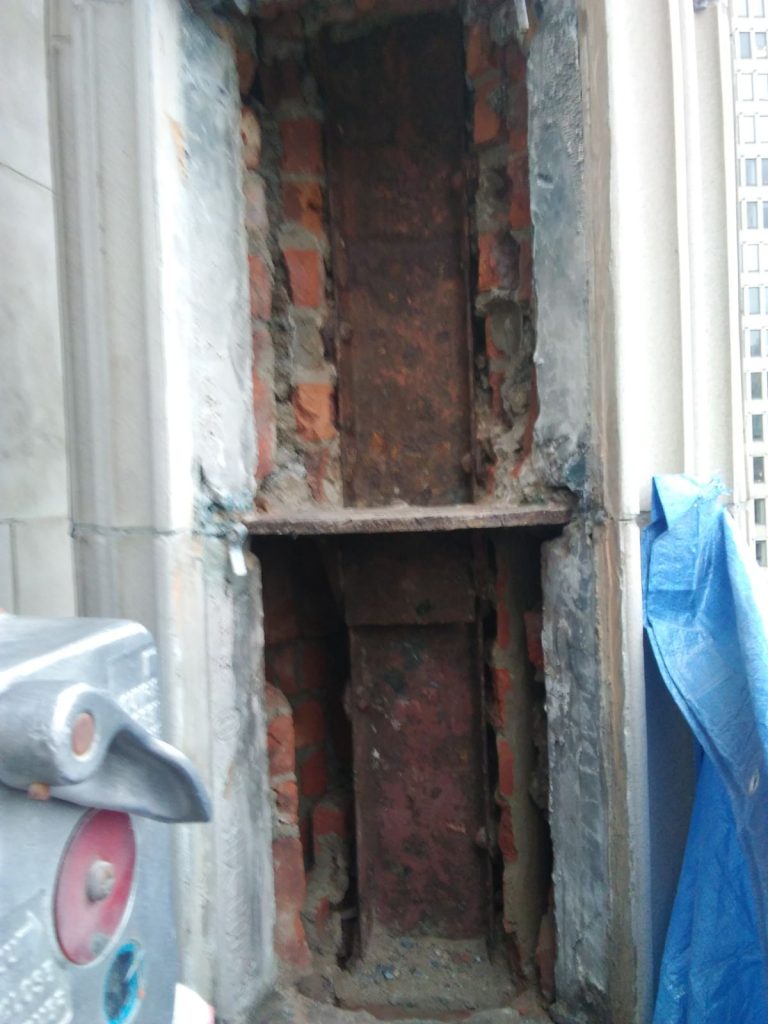
Structural Corrosion of 230 Park Avenue

Structural corrosion of 230 Park Avenue, The Helmsley Building, in NYC.

Alongside this, it has been used on the old Terry’s Chocolate Factory in York, reinforced concrete car parks, and plaza decks (Concourse in New York City).

A special ceremony will take place on Monday, March 20th, 2023, outside the Exhibit Hall entrance at the 2023 AMPP Annual Conference + Expo in Denver, CO to announce the final 10 winners.

If you’d like further information on LoCem® and how it can be used in your restoration projects, please contact cwalker@c-probe.com

C-Probe Win their Biggest Cathodic Protection Contract to Date

UK structural resilience specialist company, C-Probe, is proud to announce that they have won their biggest impressed current cathodic protection (ICCP) contract to date with the award of the sub-contract to design, supply, support, test, commission and operate the system to restore and protect the podium structures at Concourse Village Plaza, located in The Bronx in New York City.

This multi-million dollar contract involves C-Probe providing its low carbon corrosion protection anode, monitoring and management system products to protect the reinforced concrete decks, beams, walls, and columns of the structure from corrosion as well as remotely control and monitor this for years to come.

They will be working with specialty restoration contractors Infrastructure Repair Services, Inc (IRS) who will repair and upgrade the structure as well as install the ICCP system, and the owner’s structural engineering firm, Simpson, Gumpertz and Heger (SGH) who will oversee the project. Mott MacDonald – Materials and Corrosion Technology Division – is on board with C-Probe for the design of the protection system.

Concourse Village Plaza houses apartment blocks, retail shops, a multiplex cinema and underground parking. Environmental impact of chloride ingress and weathering has taken its toll on the structure with cracking and spalling of the concrete cover from reinforcement corrosion necessitating significant concrete repair in conjunction with futureproofing with ICCP.


(Above: Concourse Village Plaza in the Bronx, NYC)

An effective corrosion protection and repair strategy is designed to protect the structure for decades to come and preserve its embodied carbon as an extension to its service life without needing repetitive repairs over time.

C-Probe’s low carbon alkali-activated cementitious material (AACM geopolymer) innovation, LoCem®, will be a key aspect of this restoration project. LoCem® is specifically formulated to act as an ICCP anode cement which, when activated forms a bonded hardened mortar allows a small dc electrical current to pass through the concrete cover to the steel reinforcement, providing whole life control of corrosion.

LoCem® binders as repair, protection and build materials are a sustainable alternative to traditional cements, as it is manufactured from industrial waste by-products with no heat blending production offering over 90% CO2e saving compared to CEM I. LoCem® will be used at Concourse in the form of +chase®, specifically used for reinforced concrete structures, where the ICCP anode mortar operates within slots cut and holes drilled strategically into the reinforced concrete structural elements.


Embeddable corrosion rate probes will also be installed for ongoing monitoring and data provision to make control decisions remotely (AchillesICP), meaning the client will receive transparent data of corrosion activity, proof of performance of the installed system and service life tracking of the structure. C-Probe has also committed to monitoring the structure through their online management and reporting facility, AiMS, for at least the next 10 years, which will be invaluable for retaining asset value and making proactive maintenance decisions when needed.

(Left: LoCem® +chase® installed in a popular retail parking structure in Edinburgh, Scotland.)

With the design of the Central podium completed, construction will begin in 2023 before moving to the West and East podiums. The project and is expected to go on for the next 2.5 years.

The result of the project will be an Environmental Social Governance (ESG) compliant strategy that will create a more resilient structure, utilising low carbon build materials that can control the impact of corrosion.

LoCem® is an award-winning product has been used previously in restoration projects such as 230 Park Avenue (The Helmsley Building) in NYC (Lucy G Moses Preservation award with

Thornton Tomasetti), Terry’s Chocolate Factory in York, UK (Research, Innovation, Sustainability and Engineering – RISE award), The Commerce Bank in Kansas City (ICRI Sustainability Award and Fiatech CETI with Mott MacDonald) as well as The Best Use of Emerging Technology at the Building Innovation Awards.

(Right: Example of the structural corrosion within The Helmsley Building in NYC, which C-Probe protected in 2019.)

The technology has also been used in heritage steelframe buildings as LoCem® +point® repointing mortar with LoCem® HLM (heritage lime mortar) infill and various bridges, mining and parking structures as C-Puck® galvanic anodes with LoCem® CPM (conductive packing mortar), +chase® and +shot® products, all of which are protected successfully and sustainably.

If you’re interested in learning more about our restoration offerings and how LoCem® could benefit your project, please contact cwalker@c-probe.com or fill out the contact box below.

The Effect of Climate Change on Existing and New Infrastructure

The role of concrete infrastructure is vital to any economy. It comes in a variety of forms, such as buildings, bridges, tunnels, and ports, and given such significance to our society their resilience is important. It is well-known that the deterioration rate not only depends on material compositions and construction processes, but also relies on the on-going climatic environment during the service phase of the structures’ lifecycle. Climate change, however, will have an increasing impact on our infrastructure through precipitation, carbon dioxide levels, higher sea levels and higher temperatures. The rise of CO2e and GHGs in recent decades have begun to change our surrounding environment, making it more aggressive and causing acceleration of the deterioration processes, such as acid rain and carbonation, causing corrosion-induced cracking and spalling. This results in more costly and disruptive repairs, as well as integrity loss of concrete structures.

The Decarbonization of Concrete Repair

The good news is that there are innovative methods available for corrosion protection and monitoring of the built environment that can be retrofitted to existing structures as they age or built in from new as the structure is formed. Repurposed industrial wastes are used to create a smart alkali-activated cementitious material (AACM geopolymer) which is used as both a cement repair binder and impressed current cathodic protection (ICCP) anode which protects the embedded steel in concrete structures. LoCem®, an AACM geopolymer, offers low carbon sustainability due its production using little to no energy from waste streams derived from fossil fuels, steel, and mining. This results in 90% less CO2 emissions compared to CEM I production, which is already a huge contributor to climate change.

This combination of decarbonized concrete repair and cathodic protection provides long-term resilience to existing structures. Control of corrosion and protection of the steel retains vital embodied carbon and lengthens the structure’s service life over decades, reducing the need for complete demolition or replacement of the structure.

For new buildings, urbanisation and population growth has increased new construction significantly in the last few decades, and if it continues at this rate, it will stand in the way of the UK delivering on the Paris agreement commitments of limiting global warming to well below 2°C. Therefore, the industry should be looking at how to sustainably build new infrastructure which can endure the damaging effects of climate change.

Use of the MAU for Structural Resilience

LoCem® has recently been developed to form a factory made, moulded ICCP component that is placed on the steel rebar in-situ or before the concrete is poured of new structures. The component is called the LoCem® Modular Anode Unit (MAU) and is installed as a “plug-and-play” system with tailored current densities, helping to provide long-term sustainable, structural resilience and control over structural corrosion indefinitely. This offers an important route to protecting embodied carbon of structures.

Modular Anode Unit

Ramboll found in their new report that on average 600 tonnes of CO2e embodied carbon is emitted for a newly constructed building of 1000 m2 throughout its lifecycle. Implementation of the MAU provides a low carbon sustainable solution to help retain embodied carbon within new infrastructure, as the future protection against corrosion is partnered with monitoring from embedded corrosion rate probes. This informs on performance and reduces the chance of future disruption by remotely controlling corrosion, helping to retain the remaining embodied carbon.

Technology and innovation will have a key role to play in addressing the challenges of climate change and what affect this has on existing and new infrastructure. The combination of low carbon build materials and cathodic protection prove that there are means to reduce the disruptive effect of rust and corrosion, and that the existing steel we utilise within infrastructure can be effectively protected. Innovations such as the LoCem® MAU also shows there is an accessible way for the sector to adapt new construction methods and provide resilience from the earliest stages. Implementing technology like cathodic protection anodes that can also be used as sustainable build materials will help to achieve Net Zero goals futureproofing new and existing infrastructure against climate change effects for its whole life.

The Importance of Using Resilience Management Systems to Preserve Embodied Carbon

Following COP26 in Glasgow earlier this year, there has been an increased focus on committing to regulate embodied carbon within buildings. Norman Foster, of Foster + Partners, spoke at the conference alongside US climate envoy, John Kerry, arguing that current sustainability standards do not focus on embodied carbon and to create sustainable cities we need to pursue “higher standards” for buildings that take into account their whole-life emissions.

Embodied carbon emissions account for half of an average building’s carbon footprint. Countries such as the Netherlands, Germany, France, Sweden, Finland, and Denmark are in the process of implementing regulations to measure and limit the embodied carbon in buildings, whereas the UK has no current standardised certifications or regulations to measure and reduce these emissions. Pressure is rising for action to be taken, particularly as we move towards sustainability targets and population and building stocks continue to grow.

Embodied carbon describes the greenhouse gases associated with the construction materials and processes used to construct, maintain, and manage our built environment to the end of service life. Estimates vary, but globally, it is around 10% of energy related carbon dioxide emissions (UNEP 2020). To successfully preserve embodied carbon emissions, we must start with the fabric of the structure, particularly existing ones, placing an emphasis on utilising available technology to preserve and decarbonise the built environment for the future. Ueli M. Angst concurs, highlighting the effects of steel corrosion and the challenges society faces maintaining existing ageing infrastructure in developed countries and establishing more sustainable infrastructure in emerging countries.

How much of an issue is structural corrosion? Corrosion is the primary cause of structural degradation (NACE found that it’s responsible for 70% of damage in their Impact Report), which significantly reduces service life and value of the asset. Implementing control systems, that use cathodic protection to control corrosion of the steel, could benefit ageing structures greatly, but there is a lack of wider adoption due to lack of awareness of the benefits, as well as uncertainty around risks involved with adopting new technology. The electrochemical process of cathodic protection, and the use of this in resilience management systems, is proven to be effective corrosion control, therefore preserving the structure and tonnes of embodied carbon emissions.

By bringing together standard practices that already exist for the maintenance of structures, we can see how the use of resilience management systems can benefit service life and preserve embodied carbon. For example:

  • ISO15686 (service life planning)
  • ISO 12696, ISO15257 (design and use of cathodic protection for atmospherically exposed reinforced concrete and masonry structures) and
  • BSI PAS2035 where a Fabric First approach to durability can offer significant cost advantages and sustainable legacy gains through control of degradation of any structure at all stages of its service life.

The protection of the Omni Centre MSCP, in Edinburgh is one of many real-life case studies which demonstrate the effectiveness of resilience management systems. This is an underground reinforced concrete car park on 4-levels where cracking and spalling of the concrete cover to reinforcement steel arose from the ingress of de-icing salts from traffic accelerating corrosion.

The support beams and deck were structurally repaired traditionally, and a multi-faceted corrosion management strategy was designed on a level-by-level basis derived from a comprehensive concrete and steel condition survey undertaken by the consulting team. An impressed current cathodic protection (ICCP) system was installed to 2-levels and interconnecting ramps that demonstrated high corrosion activity in the form of an innovative low carbon anode mortar. This was implemented within chases cut into the deck and over the top of the beams. Galvanic (zinc) anodes and surface-applied corrosion inhibitors were used to areas less actively corroding to prevent future corrosion developing. All decks were installed with performance monitoring with data accessed online from open and interoperable network with ICCP controlled remotely.

Car park restoration                        Finished car park restoration

The outcome is an existing concrete structure being protected from corrosion by retrofitting technology, whilst online monitoring of the installed resilience system provides a permanent data-rich record of the structure’s performance. The restoration approach is ESG compliant as reconstruction was also a near-impossible strategy due to underground facility and electric tramlines on land, meaning a non-disruptive cathodic protection method was essential to minimise social disruption, whilst successfully increasing service life and preserving vital embodied carbon with low carbon sustainable materials.

The installation of resilience management systems, which provide corrosion protection and service life tracking of a structure, are incredibly vital to the increasing pressure of retaining embodied carbon of UK building stock.

Structural corrosion is a bigger issue than reported, and there are existing standards which can influence the implementation of the systems which will protect buildings from degradation and whilst improving their efficiency and asset value. COP26 was a highly influential event increasing awareness on the embodied carbon as an issue, and it is clear that the UK still needs to make progress in order to change and accept that existing, and effective, technology will play a significant part.

Buildoffsite’s upcoming webinar with C-Probe Systems and The MTC will look at this in depth, highlighting the alkali activated cementitious material (AACM) innovation that is currently being used by C-Probe for corrosion prevention and control, which ultimately leads to whole life protection of the structure, alongside preservation of embodied carbon. This innovation has recently been developed into a product component used for modular implementation into new build structures, providing corrosion protection and monitoring from the birth of the structure. This offsite product is part of a “kit of parts” offering a route for sustainable resilience of new building stock and retaining initial embodied carbon forever.

Preserving embodied CO2 with resilience management systems will take place on the 16th June at 9:15-10:30am. It is free for Buildoffsite members and £45 for non-members. Please register online, or please complete and return the booking form to James Nguyen.

Repost from: https://www.buildoffsite.com/news/the-importance-of-using-resilience-management-systems-to-preserve-embodied-carbon/

C-Probe Systems are exhibiting at FutureBuild 2022!

C-Probe Systems are excited to be exhibiting at FutureBuild 2022, where we are also an Innovation Partner for the exhibition! You will be able to find us at Stand E63 at the London ExCeL from the 1st  March – 3rd March 2022.

FutureBuild is known for being the home of innovation, bringing together pioneering manufacturer and suppliers that are changing the face of construction and the built environment. The show is curated into six sections, providing you with innovative solutions that are addressing the biggest challenges the industry is currently facing. These sections are Buildings, Energy, Critical Infrastructure, Interiors, Offsite and Resourceful Materials. You will be able to find us within the Resourceful Materials section, as this focuses on low carbon products that are enabling the reuse of buildings and encouraging a circular economy.

We are also using this exhibiting opportunity for our latest product launch: the LoCem® Modular Anode Unit (MAU)!  The MAU is a factory-made impressed current cathodic protection (ICCP) component that can be attached in an array directly to steel reinforcement in-situ or in the precast factory prior to pouring the concrete. It can be used on any concrete structure which needs steel protection, including new buildings, car park structures, bridges – any civil infrastructure!


The MAU is currently featured in FutureBuild’s innovation gallery, as the use of its technology during the early stages of construction is most valuable in terms of asset value, whole carbon cost and retention of embodied carbon. Alongside this, it offers a sustainable route for new construction to protect assets from day one, as it uses LoCem®, an alkali activated cementitious material which is manufactured in an ambient blending and moulding process by repurposing industrial wastes. A significant amount of CO2e emissions can be saved, whilst providing sustainable resilience to new structures.

C-Probe will also be part of the innovation pitches highlighting the latest industry technologies. These 15-minute pitches will run across the 3 afternoons of the show – you can find us at the Innovation Stage, sponsored by BEIS, at 14:30pm – 14:45pm on the 1st March. Our talk is called “Decarbonisation over the Whole Life of Structures using Resilience Management Systems” which will discuss the wider impact our technology has on embodied carbon in the built environment, and will then look at our latest innovation, the MAU.

The team are very much looking forward to the show and hope to see you at Stand E63! If you haven’t registered for the show yet, you can here:

Creating Long-lasting, Sustainable Infrastructure with the LoCem® Modular Anode Unit

Widespread investment and financial resources are needed to address one of the most talked about topics in recent years: climate change. The effects of climate change are proving disastrous for the environment, and it’s vital that key industries, like construction, are contributing to reducing emissions, adapting their processes and building in future resilience. Ueli M. Angst highlights how society faces two main challenges: maintaining existing ageing infrastructure in developed countries and establishing more sustainable infrastructure in emerging countries[1].

Despite the encouragement around retrofitting and restoration of deteriorating structures, new construction will still be required across both emerging and developed countries. It is essential that parts of the construction community come together to create a sustainable strategy for creating new infrastructure and ensuring it endures the test of time.

For the first time, C-Probe Systems is launching a product specifically for new construction in the built environment in order to prevent and offer control over steel corrosion, an issue that is prevalent in existing infrastructure. The LoCem® Modular Anode Unit (MAU) is a factory-made  moulded impressed current cathodic protection (ICCP) component that can be attached in an array directly to steel reinforcement prior to pouring the concrete.

3D Drawing of the LoCem Modular Anode Unit


The purpose of the MAU is to offer vital protection from day one and prevent structures entering into a state of disrepair years into the future, by incorporating the use of cathodic protection at the design and construction stage. The MAU is suitable for all new construction projects, including buildings, bridges and car parks, where the reinforcement steel needs protection.

It offers sustainable resilience through the low carbon alkali activated cementitious geopolymer (LoCem®), which acts as a cathodic protection anode as well as a highly durable cement. Cement is an essential industry but with Portland cement producing around 8% of harmful global emissions, construction needs to start exploring innovative alternatives and adjusted formulations to drive down emissions.

The MAU provides easy installation  for contractors and precast producers, as it can be push-fitted to a range of steel diameters, during steel construction. As its name suggests, the wiring between the MAU is also modular and simplifies the electrical installation. Routing of the interconnecting modular wiring can be made at the precast factory in box-outs and completed after delivery to site, making the completion of the installation more efficient.

Download the MAU Product Technical Sheet here!

Installation of the product is also described as ‘Plug and Play’, as the wiring is routed to the zonal enclosure, with the network routed between enclosures to the Network Access Unit for communication and control of protection current, that can be altered to different current densities depending on the layout of the reinforcement steel . When this is coupled with C-Probe’s resilience management networks, the MAU is easily and remotely monitored and controlled online. C-Probe’s Achilles Interactive Management Server, or AiMS, takes the structural data and offers clear reporting for performance now and further into the future. Having these important data means clients can take preventative action instead of deferring maintenance, the value of the asset is protected, and they have peace of mind that they have a healthy, functional structure for its whole life.

Technology and innovation will have a key role to play in the switch to a low carbon economy with sustainable infrastructure and the LoCem® Modular Anode offers an accessible way for the sector to achieve this. Through the integration of digital technologies with physical assets, we are able to generate, harvest and analyse important structural data which can ultimately create sustainable resilience for infrastructure. The need to reduce emissions and new construction is vital as we move towards NetZero, and implementing technology like this, alongside the use of low carbon materials such as LoCem®, from day one will allow us to do that.

[1] Angst, U.M., Challenges and opportunities in corrosion of steel in concrete, Materials and Structures, 51:4, 2018

Interested in talking further about the LoCem® Modular Anode and how it can help your current projects? Please get in touch with C-Probe Systems at cwalker@c-probe.com or submit a query via our website www.c-probe.com.

C-Probe Win at the Building Innovation Awards!

C-Probe are incredibly pleased to announce that their list of acknowledgements and awards continues to grow in 2021! We have won the category ‘Best Use of Emerging Technology’ at the Building Innovation Awards for our low carbon, smart alkali-activated cementitious cement (AACM geopolymer) cement binder, LoCem®! Alongside this, C-Probe were named as a Top 100 Manufacturer at Digital Manufacturing Week in Liverpool.

The C-Probe team attended the Building Innovation Awards ceremony, which we also sponsored, in Manchester on 4th November 2021 which brought together the UK’s key player in the construction industry to celebrate the latest innovations. The Building Innovation Awards look to recognise organisations which are changing the landscape of modern construction through innovative materials and technologies, which not only boost profits, but also deliver a greener, smarter, and safer built environment. The Manufacturer works in a similar vein, looking to recognise pioneering individuals and celebrating their industry success in their Top 100 Alumni.

The recent accolades are additions to C-Probe receiving two awards from the Leeds Beckett University RISE Awards, which places a focus around sustainability, and being published in the CIRIA Sustainability Champions report. All the above recognise C-Probe’s innovative drive towards NetZero and their focus on whole life preservation of structures through corrosion mitigation and demonstrate a shift in the sector in accepting new technologies.

Graeme Jones, CEO of C-Probe Systems, comments on the recent wins:

The drive to low carbon and NetZero has provided a focus to the value of these innovations that is very satisfying to see given the three decades of trying to have this message heard. All of achievements that have been awarded to us this year demonstrate the growing acceptance of our technology and how sustainability is fast becoming a priority – it’s exciting for us as a business. We are proud to have a made such a significant impact and will continue to combat climate change through sustainably protecting and creating more resilient structures.”

For those who aren’t familiar with C-Probe’s innovation, and the base technology for all their products, LoCem® is used for the restoration of existing masonry and concrete structures, helping to retain embodied carbon and improve energy efficiency. Its unique feature is that it can be used as a repair material and an anode, forming part of a system which is retrofitted into the structure, helping to provide long-term monitoring and resilience. LoCem® serves as a sustainable alternative to traditional materials, as powder binders are produced by repurposing industrial wastes from steel, fossil fuels and mining, when hardened in application-targeted mix designs. It has comparable physical performance as conventional Portland cements mortars, grouts, and concrete and offers over 80% less CO2 emissions.

Look at some of the photos from the night!

If you’re interested in discussing our services for any upcoming projects, please get in touch with enquiries@c-probe.com

Get in touch with any questions, queries or potential projects.