
25 Years of Service Life Control:
C-Probe’s Track Record in Bridge Joint Cathodic Protection
General view of Bervie Jubilee Bridge in Aberdeenshire
From the unknown to fully data-driven resilient solutions
Overview
Over 400 UK highways bridges have been constructed with suspended decks reliant on their structural functionality on half and hinge joints. These bridges are strategic structures carrying principal A-roads and motorways.
These joints are heavily and complexly reinforced with issues arising from failing deck joints allowing chloride-entrained water to percolate down into the joint often ponding on the flat table section prior to continuing its path through gravity to the nib of the joint visible from the soffits.
Bridge half-joints are among the most vulnerable reinforced concrete details in highway structures. Leakage through expansion joints allows chloride-contaminated water to penetrate deep into concrete, accelerating reinforcement corrosion and leading to cracking, spalling, and progressive structural deterioration.
Conventional repair methods are often disruptive and may not address corrosion occurring at depth within complex joint and steel geometries. In the 1990s, these limitations prompted detailed investigation into alternative electrochemical protection methods capable of delivering long-term control in difficult-to-access zones.
C-Probe has designed and applied discrete, drilled-in ICCP systems to address this issue with over 25 years of control and performance data. In the late 1990s this was pioneering given that no bridge had at that time had such a design undertaken or implemented.
This overview traces that development from early investigative and ICCP design development work on M1 motorway viaducts and overbridges in Leicestershire, Nottinghamshire and Cambridgeshire during the 1990s. This work lead to extensive use of discrete anode ICCP at Woodhouse Lane Viaduct near Worksop and Bervie Jubilee Bridge in Aberdeenshire in 2009.
All these bridge structures have been installed with embedded corrosion rate monitoring probes, open network power, control and monitoring systems (AchillesICP) and operated remotely online using C-Probe’s AiMS facility.
The Challenge: Bridge Half-Joint Corrosion
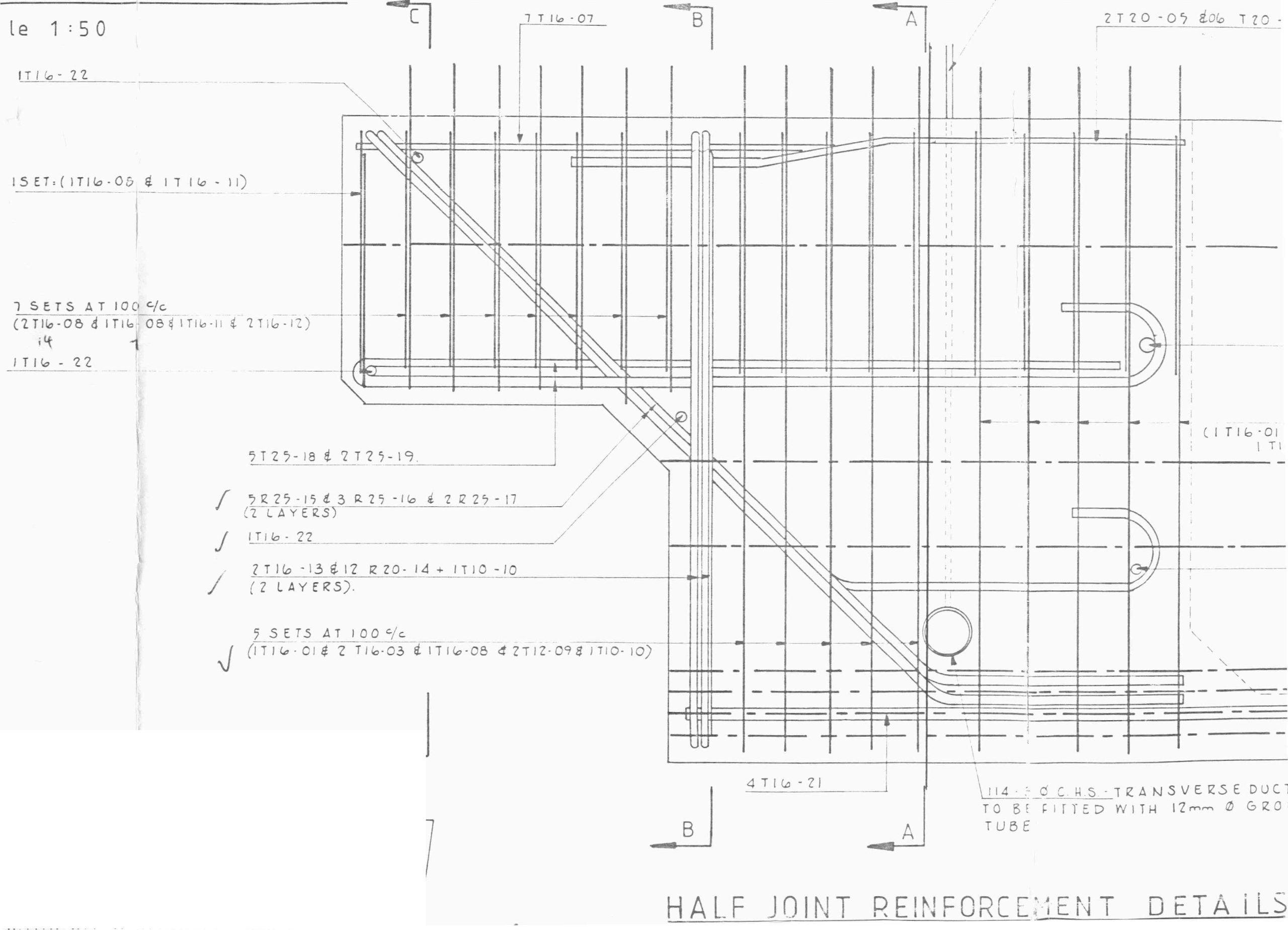
Congested half joint steel arrangement
Applying impressed current cathodic protection (ICCP) is also not possible from a surface-applied system due to steel congestion through depths of up to 1-1.5m from soffit to top deck. This masks the throw of the protection current that would result in under-protection.
The only viable method of providing control was therefore to drill anodes deep into the joints to provide 3-dimensional current throw directly at the heart of the structural elements.
River Avon Viaduct
In spring 1994, C-Probe was commissioned to assess corrosion damage at the River Avon Viaduct, with particular focus on characterising the condition at Joint 5, identified as the most severely affected to inform on the viability of applying the technique over all 8 joints.
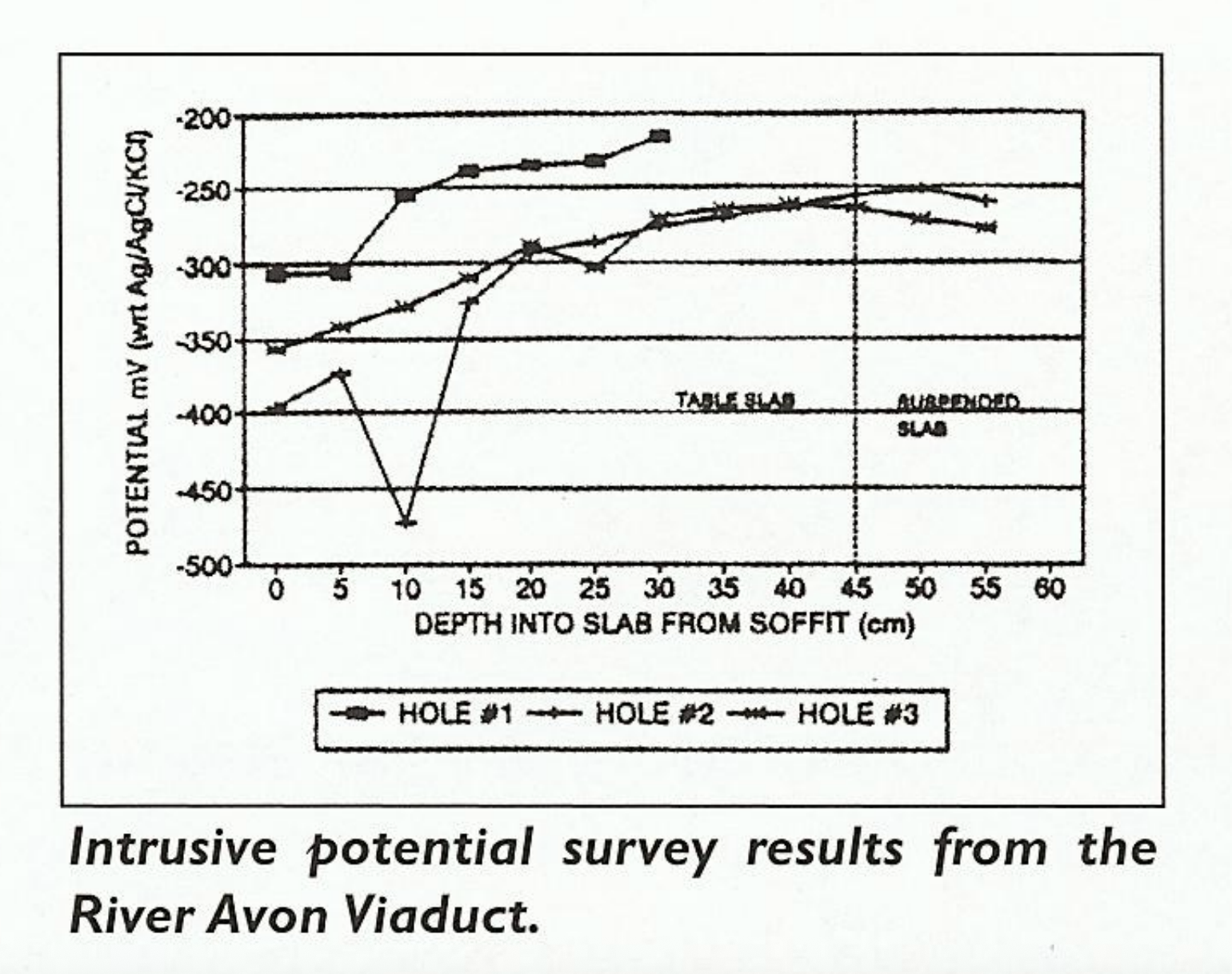
A combination of diagnostic techniques was employed:
- Surface half-cell potential mapping
- Deep-hole three-dimensional half-cell potential profiling
- Deep-hole chloride sampling
The investigation identified the table-to-suspended slab interface as the highest-risk zone with corrosion potentials more negative than -350mVCSE. Chloride concentrations were recorded between 0.45% and 0.92% by weight of cement, indicating advanced contamination not detectable through conventional surface inspection alone.
Development of the Anode System Solution
At the time of the investigation, no commercially available discrete anode system existed that had been installed within complex half-joint geometries so the design stage was pioneering.
C-Probe evaluated and adapted candidate materials before supporting the selection of conductive ceramic discrete anode, chosen for its durability and electrochemical stability. These were installed each side of the joint to a CP
limiting distance of 1m each side in arrays along the 50m length of each joint and through depth between reinforcement steel to 200mm and up to 750mm.
In more modern applications these anodes would be replaced with low carbon geopolymer anode mortar solutions to integrate on hardening with the parent concrete with comparable strength and inbuilt acid resistance.
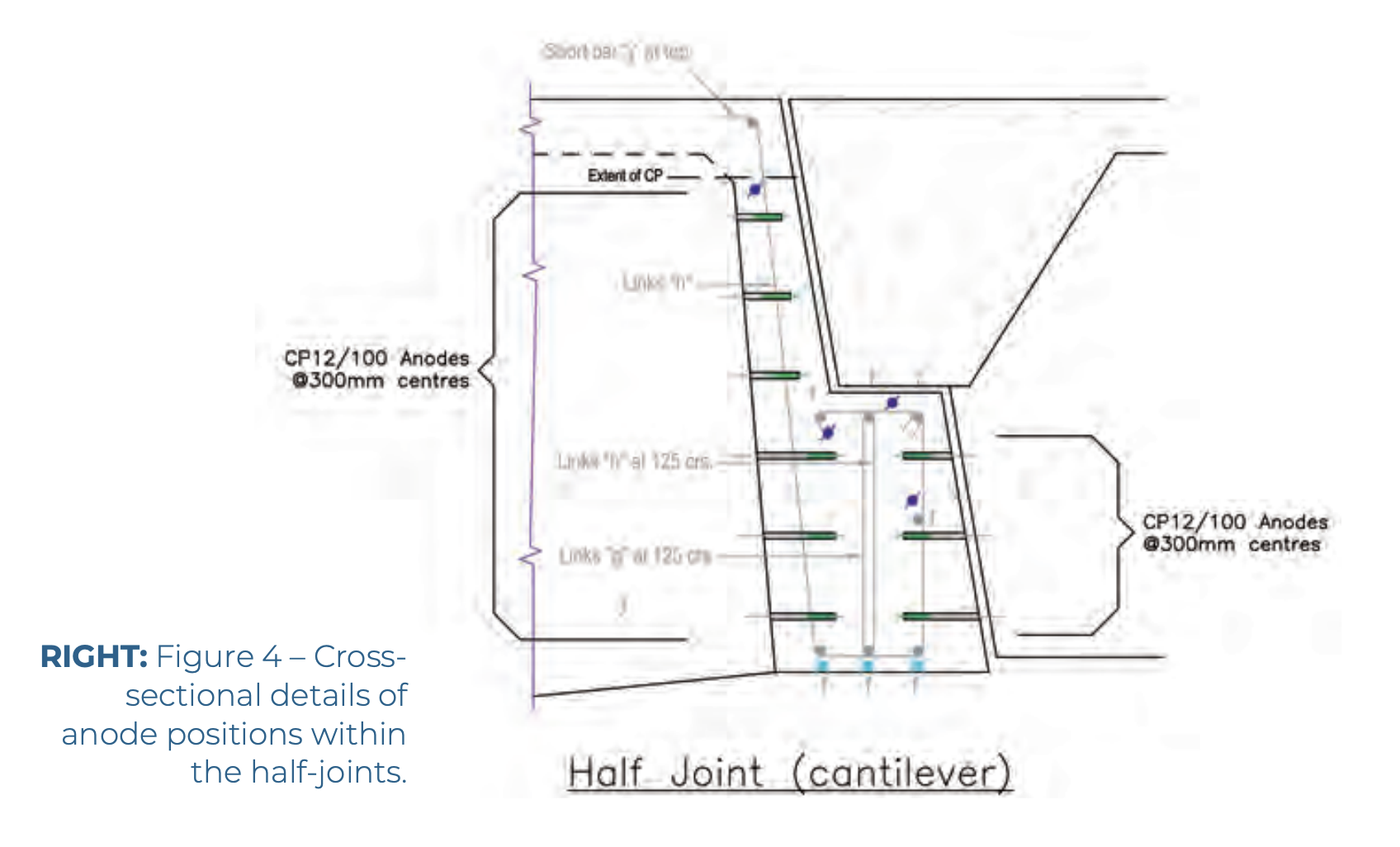
In parallel, a monitoring and control framework was installed, incorporating:
- Embeddable reference electrodes (C-Probe CP10P)
- Embeddable corrosion rate probes (C-Probe CP101)
- AchillesICP network power, control and monitoring system
These components enabled continuous online measurement and control of steel potential and corrosion activity during energisation and service operation in accordance with ISO12696 in its iterations and updates over the years.
Implementation and Early Adoption
The system was successfully energised in August 1998. Following its performance at the River Avon Viaduct, similar discrete ICCP systems were subsequently implemented on three additional overbridges at Wansford, Twyford, Swinford Road, J23 interchange of the M1 motorway and Woodhouse Inn Viaduct.
These early applications demonstrated that deep-seated corrosion within bridge half-joints could be effectively controlled without major structural intervention or prolonged traffic disruption, establishing a viable long-term alternative to conventional concrete repair strategies. These were also setup for online performance monitoring and remote control on C-Probe’s AiMS facility.
ICCP to historic and modern viaducts
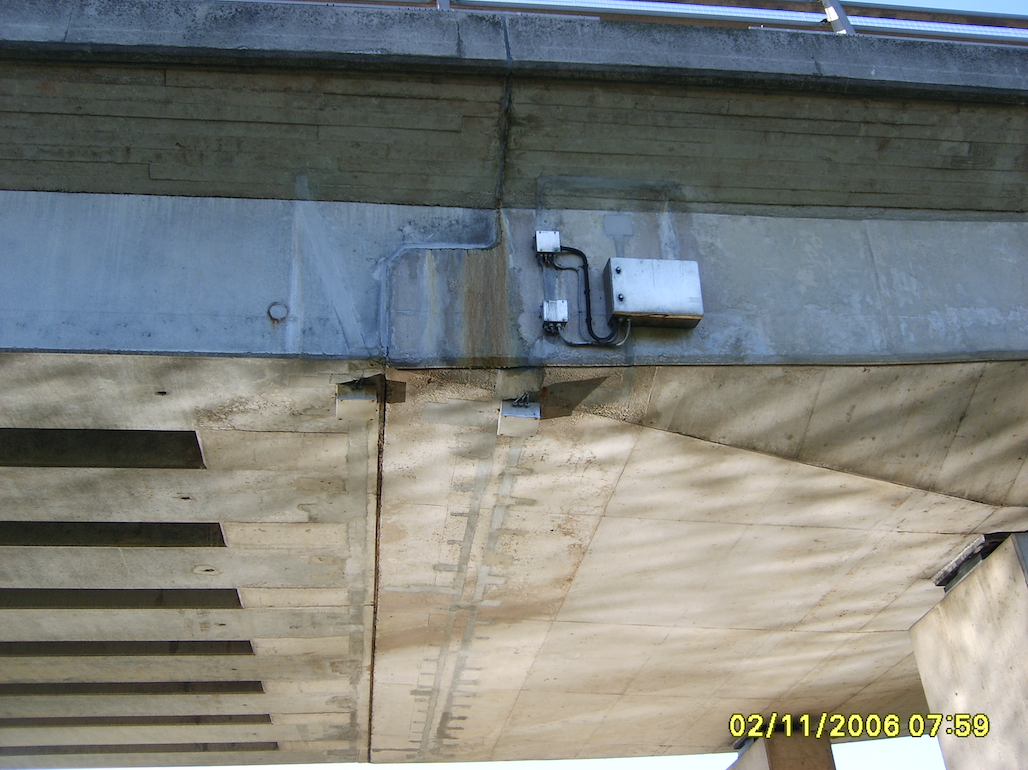
AchillesICP management system installed to a half joint at Woodhouse Inn Viaduct
Discrete anode systems were installed extensively at Bervie Jubilee Bridge and Woodhouse Inn Viaduct to extend the service life of reinforced concrete elements to half-joints, cantilever beams and suspended slabs while minimising visual impact and disruption to the existing structure.
The system operates by applying a low-voltage direct current through embedded discrete anodes, shifting the electrochemical conditions of the steel reinforcement to a protective range and thereby suppressing corrosion activity.
The installation comprises:
- Discrete anode arrays
- Permanent corrosion rate and reference monitoring probes
- Junction boxes and cabling infrastructure
- Zoned power supply and remote monitoring systems
Current distribution is managed across defined zones to ensure uniform protection across areas with varying chloride exposure levels.
Key advantages of this approach include targeted corrosion control, minimal concrete breakout during installation, adaptability to complex geometries, and the ability to continuously monitor and adjust performance throughout service life.
Long-Term Performance and Asset Value
Since 2009, these systems have been continuously monitored and maintained either under the management of Structural Healthcare Limited or . Over this period, no additional intrusive remedial works have been required.
This sustained performance has resulted in:
- Elimination of repeat structural repair interventions over 17+ years
- Significant reduction in maintenance-related disruption
- Estimated embodied carbon savings of approximately 3,132 tCO₂e
Typical reinforced concrete bridge repairs influenced by chloride-induced corrosion are often required within 5–15 years, depending on exposure conditions and construction detailing. Based on conservative lifecycle assumptions for a medium-sized bridge asset, deferred intervention can represent avoided future repair expenditure in the order of several hundred thousand pounds per intervention cycle.
These outcomes demonstrate the value of long-term and actively controlled corrosion mitigation strategies in reducing whole-life infrastructure costs by extending serviceable asset life.
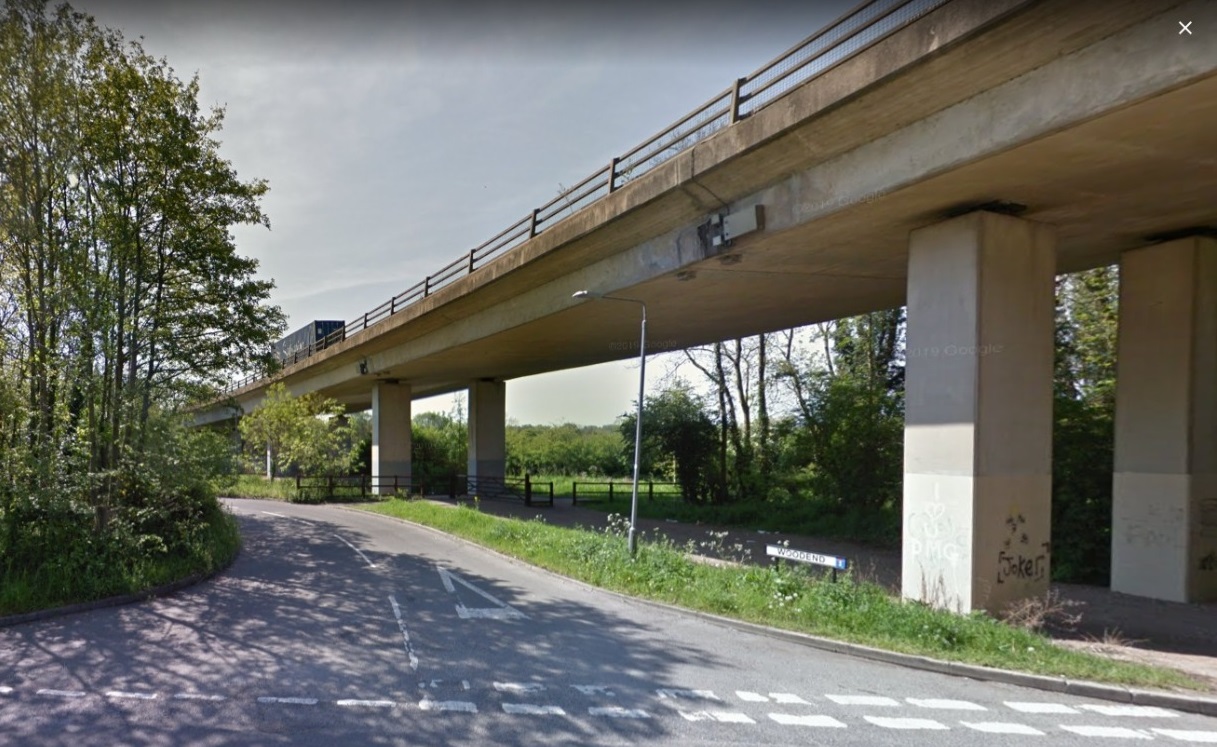
General view of Woodhouse Inn Viaduct
Conclusion
From early investigative work on the River Avon Viaduct in the 1990s through to long-term monitored performance at Bervie Jubilee Bridge and other bridge assets, C-Probe has demonstrated the effectiveness of discrete anode ICCP systems in controlling reinforcement corrosion in challenging bridge environments.
Over more than 25 years of development and application, discrete anode ICCP technology has proven capable of extending service life in complex steel arrangements, reducing intervention frequency, and supporting more sustainable infrastructure management through targeted, low-disruption and online corrosion control with performance reporting.