
Cathodic Protection of Post-Tensioned Tendons for Resilience Management of Parking Structures
Photograph shows a general view of Longfellow Towers above the underground parking facility
Overview
It is often overlooked when considering the long-term corrosion protection of post-tensioned and prestressed tendons that impressed current cathodic protection (ICCP) offers sustainable durability and control of both corrosion and the risk of hydrogen embrittlement (HE).
The risk of HE is reduced where plastic ducts are present rather than galvanised ducts where bimetallic corrosion can result in the inducing of hydrogen to cause HE. However, strict controls can be placed with the use of ICCP where no tendon polarisation more negative than -900mVCSE would mean that it is thermodynamically not possible to form hydrogen in the cathodic reaction.
It is with this criterion in mind that ICCP was adopted to protect exposed PT tendon ends at joints within the underground parking structure at Longfellow Towers in Boston, MA.
The Longfellow Towers & Garage is a landmark residential development overlooking the Charles River in Boston, Massachusetts. Constructed in the early 1970s, the development comprises two 38-storey residential towers above an underground post-tensioned concrete car park.
Following condition surveys, corrosion-related deterioration was identified within both the reinforced concrete elements of the towers and the post-tensioned tendon anchorages within the underground structure.
Whilst the reinforced concrete exhibited cracking and spalling caused by reinforcement corrosion, the condition of the post-tensioned anchorages presented a significant long-term durability concern.
In 2001 and implemented over the 2000s, C-Probe designed, supplied and operated a discrete anode ICCP system to protect the post-tensioned tendon anchorages, extending the service life of the structure and providing a durable, long-term corrosion protection solution. The system has now been in place and operating successfully for over 25 years.
The Challenge
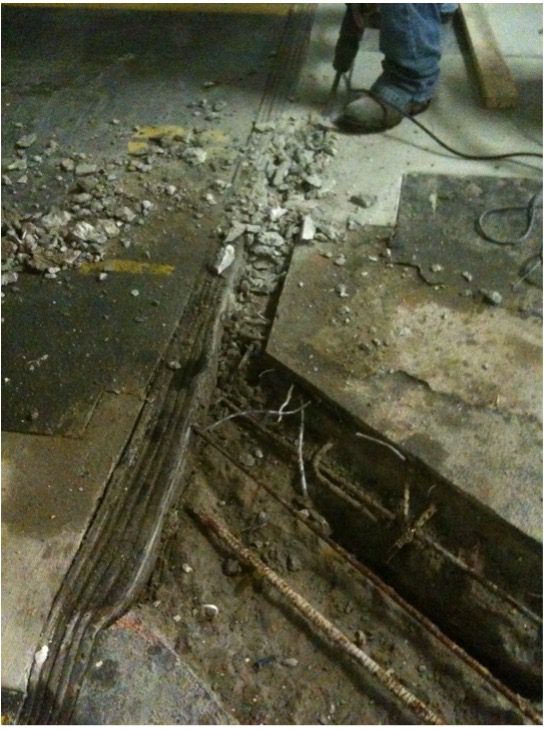
Photograph shows a section of the construction joint with tendon anchorages exposed
Detailed investigations established that carbonation had progressed through the concrete cover, reducing the natural protection afforded to the embedded reinforcement. Chloride contamination was also present, further accelerating the corrosion process.
Within the underground post-tensioned concrete car park, corrosion was developing around the post-tensioned tendon anchorages. Due to the structural importance of these components, any continued deterioration posed a significant risk to the long-term durability and performance of the structure.
A corrosion protection strategy was therefore required that would:
- Protect the post-tensioned tendon anchorages from further corrosion
- Extend the service life of the structure
- Minimise future maintenance requirements
- Integrate with the wider concrete repair and protection programme across the development
Our Solution
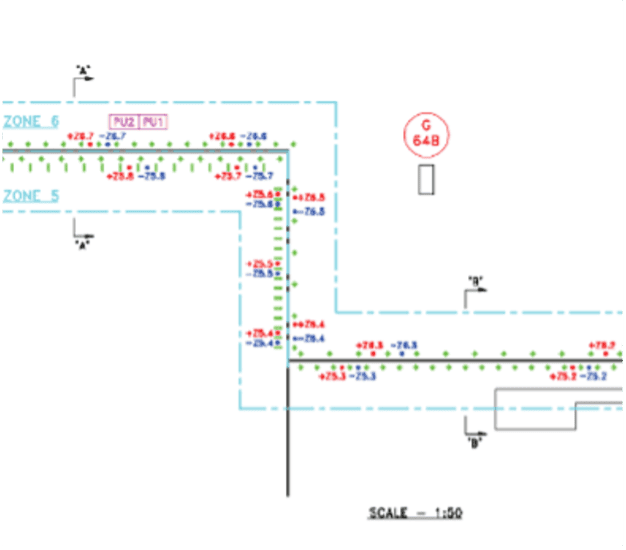 The refurbishment strategy combined concrete repair with advanced corrosion protection technologies to provide a comprehensive long-term solution.
Repairs were undertaken to the reinforced concrete elements of the residential towers, followed by the application of a corrosion inhibitor treatment and anti-carbonation protective coating to reduce the risk of future deterioration.
Within the underground structure, C-Probe designed an ICCP system specifically engineered to protect the post-tensioned tendon anchorages using a discrete anode system drilled-in to multiple depths to protect all steel through the deck and interconnected with titanium feedwire.
Corrosion potential and rate monitoring was established with embedded probes (C-Probe CP101) for performance assessment in accordance with ISO12696.
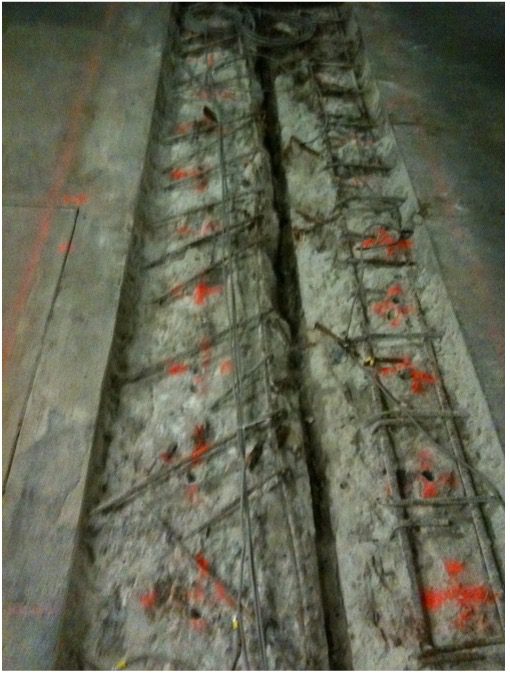
Photograph shows the positioning of discrete anodes along the construction joint
The system applies a carefully controlled protection current to the steel, mitigating ongoing corrosion activity by impressing the potential of the tendon and surrounding steel to safe levels so preserving the structural integrity of the post-tensioned system.
Continuous monitoring and control are provided through an interoperable open-network management system:
- AchillesICP to the parking structure and
- AchillesIES – inhibitor evaluation system – to the Towers following application of Sika Ferrogard 903 inhibitor and anti-carbonation coating to the façades)
enabling long-term performance verification and efficient asset management and reporting online with C-Probe’s AiMS facility.
Results and Benefits
The completed corrosion protection strategy has significantly enhanced the long-term durability of both the residential towers and the underground post-tensioned structure.
The ICCP system continues to provide effective corrosion protection to the post-tensioned tendon anchorages, helping to safeguard the structural integrity of this prominent residential development whilst reducing future maintenance requirements.
The project received International Concrete Repair Institute (ICRI)recognition in concrete repair and corrosion protection, including:
- ICRI High Rise and Parking Award of Excellence – 2007
- ICRI Longevity Award of Merit – 2013
Summary of Key Benefits:
- Long-term protection of post-tensioned tendon anchorages
- Extended service life of the structure for over 25 years and counting
- Reduced risk of corrosion-related deterioration
- Continuous control of risk of HE
- Continuous monitoring and performance verification
- Integrated corrosion protection and concrete repair solution
- Reduced whole-life maintenance costs
- Preservation of embodied carbon with sustainable technology.